Embed Code for Kelvin Helmholtz Instability CFD Simulation
Copy the embed code below to include this project on your website:
Kelvin helmholtz instability cfd simulation
NoAI: This project, including models, simulations, images, and descriptions, may not be used within datasets, during the developmental process, or as inputs for generative AI tools.
About the Kelvin Helmholtz Instability CFD Simulation Project
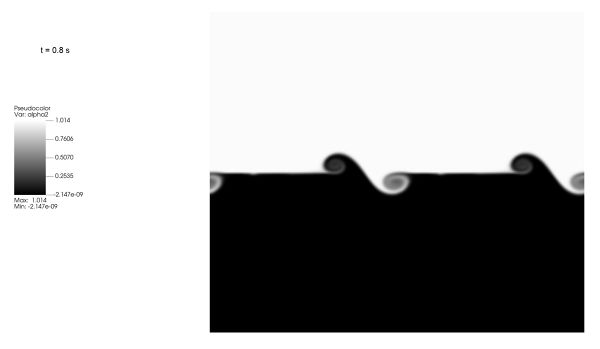
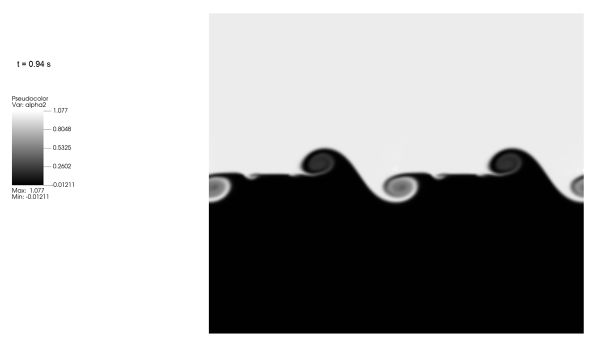
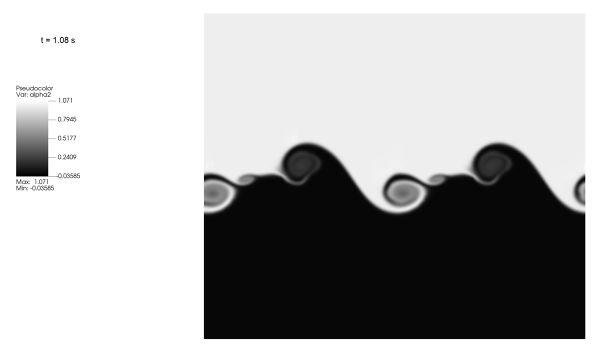
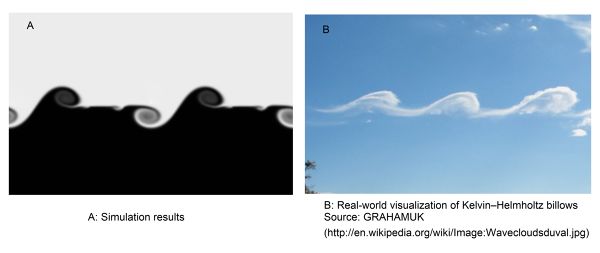
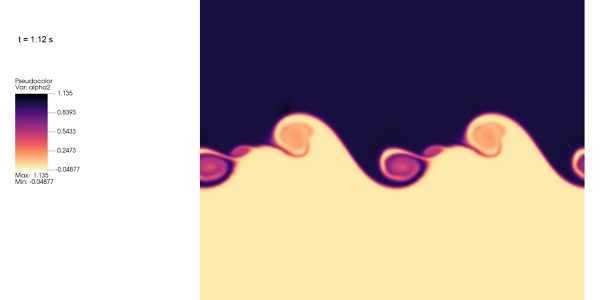
This simulation presents a two-dimensional Kelvin–Helmholtz instability computed using the NumericalAI (https://numericalai.net/), where two immiscible compressible fluids occupy the lower and upper halves of a unit square domain discretized on a 256x256 grid with fully periodic boundary conditions. Kelvin–Helmholtz instability is a fluid-dynamics process in which velocity shear between two adjacent fluid layers causes the interface to ripple and then roll up into wave-like billows and vortices. It appears in settings ranging from clouds and ocean currents to planetary atmospheres and space plasmas, and it is widely studied in meteorology, oceanography, and astrophysics. The fluids are initialized with equal pressure but opposite horizontal velocities (±0.5), creating a sharp shear layer at y=0.5, while a small, localized transverse velocity perturbation with amplitude 𝐴=10−2, Gaussian thickness 𝜎=0.05, and sinusoidal mode number 𝑘=2 seeds the instability. A fifth-order mapped WENO scheme with an HLLC-type Riemann solver and a third-order time integrator is used to accurately capture the nonlinear evolution of the interface. As time progresses, the initially smooth interface rolls up into characteristic Kelvin–Helmholtz billows, forming coherent vortical structures that grow and interact, as visualized through the volume fraction (𝛼2) contours shown at successive times. Cloud ‘fluctus’ provides a striking real-world visualization of Kelvin–Helmholtz billows: shear at an interface forms waves that roll up into vortices, resembling the simulated α-field roll-up. Note, however, that the atmosphere adds stratification, moisture/condensation, turbulence, and 3-D effects, so the comparison is qualitative rather than a strict validation. Real world kelvin helmholtz instability image source: GRAHAMUK (http://en.wikipedia.org/wiki/Image:Wavecloudsduval.jpg)
View Kelvin helmholtz ins... - Compressed 3D Model (GLTF)
Statistics
1 Downloads
0 Likes
1678 Views
0 Comments
5 Files
0 MB Project Size
January 31st, 2026 Uploaded
Share
Share Tweet Pin Share Share Post ShareAtif Masood
266 Projects
823 Likes
16483 Downloads

Related Projects


Sign up to join the conversation about Kelvin Helmholtz Instability CFD Simulation
Post a comment! Share insights on Kelvin Helmholtz Instability CFD Simulation, ask questions, and connect with other users. Whether you're curious about the 3D model, fluid simulation, or finite element analysis, your comments enrich the conversation.
No responses added yet.