Embed Code for Human Aortic Arch CFD Analysis
Copy the embed code below to include this project on your website:
Human aortic arch cfd analysis
NoAI: This project, including models, simulations, images, and descriptions, may not be used within datasets, during the developmental process, or as inputs for generative AI tools.
About the Human Aortic Arch CFD Analysis Project
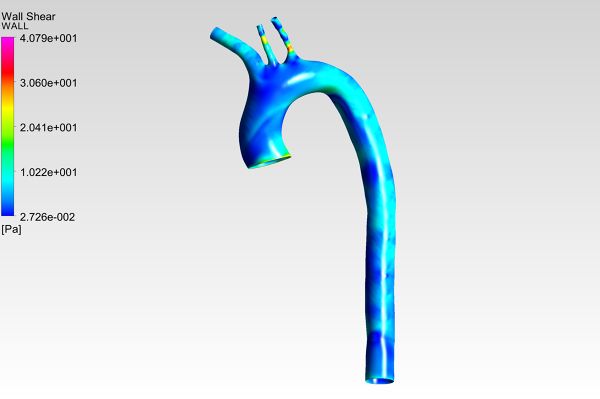
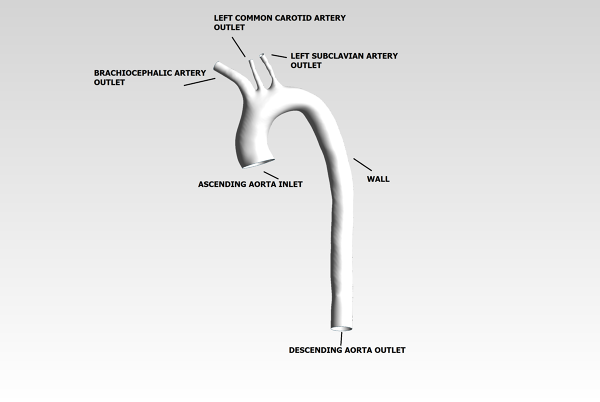
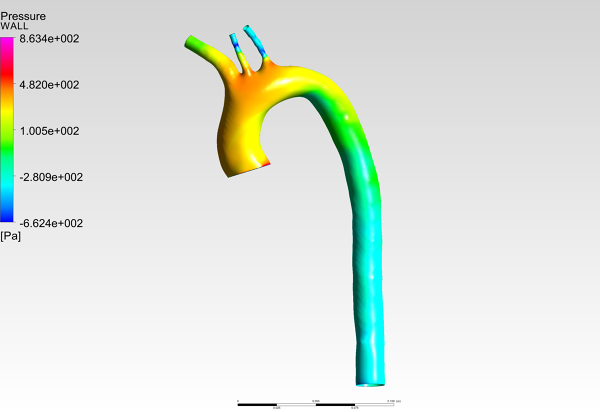
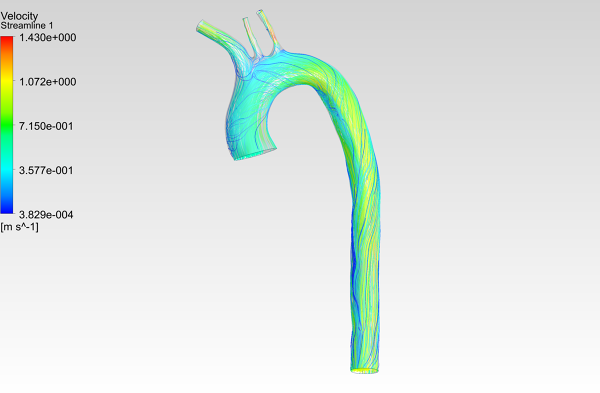
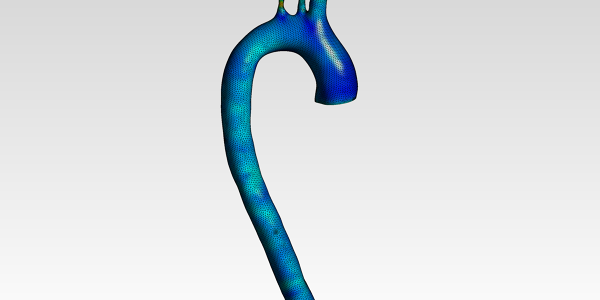
This CFD simulation investigates blood flow through an aortic arch geometry, including the ascending aorta, descending aorta, and the three major supra-aortic branches: the brachiocephalic artery, left common carotid artery, and left subclavian artery. Blood is modeled as an incompressible Newtonian fluid, and the vessel wall is treated as a rigid no-slip boundary. A prescribed inlet velocity is applied at the ascending aorta, while flow exits through the descending aorta and the three arch branches according to the selected outlet conditions. The simulation captures key hemodynamic features such as flow acceleration through the curved arch, branch flow distribution, pressure drop from the inlet to each outlet, and wall shear stress patterns along the vessel wall. Localized high-WSS regions appear near branch takeoffs and narrowed/curved vessel sections, where the flow experiences stronger acceleration and near-wall velocity gradients. This type of simulation is useful for visualizing and analyzing aortic arch hemodynamics, including how vessel curvature and outlet branching influence pressure, velocity, and wall shear stress distribution. Original CAD model of the human aortic arch used in this CFD analysis is by Abdu Yearwood (https://grabcad.com/abdu.yearwood-1)
Statistics
0 Downloads
0 Likes
478 Views
0 Comments
4 Files
2 MB Project Size
June 28th, 2026 Uploaded
Share
Share Tweet Pin Share Share Post ShareAtif Masood
266 Projects
824 Likes
16491 Downloads
Tags
Human Aorta Human Aorta simulation Blood Flow Hemodynamics Hemodynamics CFD Simulation Hemodynamics CFD Analysis Medical Simulation Biomedical CFD
Categories
Refetch of
Sponsored Ad from FindingDIY

Related Projects


Sign up to join the conversation about Human Aortic Arch CFD Analysis
Post a comment! Share insights on Human Aortic Arch CFD Analysis, ask questions, and connect with other users. Whether you're curious about the 3D model, fluid simulation, or finite element analysis, your comments enrich the conversation.
No responses added yet.